Writting Heart Script Font for Handmade Creators
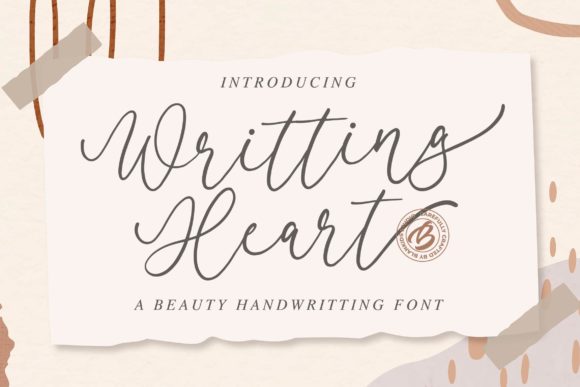
It started with a candle label — just one small 2.5-inch oval sticker I was designing for a lavender-vanilla soy blend. I’d tried three fonts already: one too stiff, one too fussy, one that didn’t hold up at tiny sizes. Then I opened Writting Heart, typed “Breathe Deeply,” and instantly knew — this was the script font that felt like handwritten warmth, not digital perfection. Writting Heart is a beautiful and stylish script font. Add it confidently to your projects, and they will be impeccable. As a Script Handwritten typeface, it carries rhythm, grace, and subtle personality — like ink dipped just right and guided by a steady hand.
Writting Heart for Candle Labels and Handmade Product Packaging
When you’re printing dozens of candle labels on matte sticker paper or kraft tags, legibility and charm must coexist. Writting Heart shines here — especially in medium-to-large sizes (14–24 pt) where its natural flow and gentle contrast read clearly without sacrificing elegance. I used it for scent names (“Wild Mint & Rain,” “Honeyed Amber”) paired with a clean sans serif (like Montserrat Light) for ingredients and warnings — a classic Script Handwritten + minimalist pairing that elevates shelf presence. Because Writting Heart is PUA encoded, I accessed alternate lowercase “a” and “g” glyphs to avoid repetition across six different scents — giving each label its own quiet distinction. For physical packaging, test print at actual size first: swashes look gorgeous on front-of-box banners but can blur on 3/4-inch hang tags, so I reserved those flourishes for larger elements like jar seals and thank-you cards.
Writting Heart for Wedding Invitations and Elegant Branding
My cousin asked me to design her wedding stationery suite — save-the-dates, main invites, menu cards, and a welcome sign. She wanted “romantic but not frilly, timeless but not stiff.” That’s exactly where Writting Heart lives. As a Script Handwritten font, it brings soft authority — think calligraphic confidence without overwrought loops. I set couple names in Writting Heart at 36 pt for the invitation’s focal line, then dropped in a swash capital “J” (using the PUA-encoded glyph) before “Julia & Alex” for a custom touch. For body text, I paired it with a warm serif (Cormorant Garamond) — a balanced, printable-friendly combination that prints crisply on ivory cotton paper. Since Writting Heart is PUA encoded which means you can access all of the glyphs and swash, I swapped standard punctuation for elegant ampersands and decorative periods — details guests notice when holding something tangible in their hands.
Writting Heart for Printable Wall Art and Digital Downloads
For my Etsy shop’s printable collection — affirmations, seasonal quote sets, and planner headers — Writting Heart became my go-to display font. Its confident curves and open letterforms scale beautifully from 120 pt wall quotes down to 18 pt section dividers in undated planners. As a Fonts choice for digital creatives, it adds premium texture without overwhelming layouts. I always export two versions: one with swashes enabled (for preview thumbnails and hero images), and one with standard characters only (for editable Canva templates — some users disable advanced OpenType features). Because Writting Heart is a beautiful and stylish script font. Add it confidently to your projects, and they will be impeccable, it helps my listings stand out in search results where buyers scroll past generic sans serifs and overused scripts.
Writting Heart for Greeting Cards and Boutique Tags
Hand-lettered greeting cards sell best when they feel personal — not mass-produced. Writting Heart delivers that handmade authenticity while staying production-ready. I use it for short phrases (“You’re Loved,” “Happy Little Birthday”) on A2 folded cards, always kerning tightly and adjusting tracking slightly to preserve rhythm. For boutique gift tags (1.75" x 3"), I stick to title case and avoid swashes — but I do use the PUA-encoded alternate “y” and “e” to soften edges and keep readability high on thin twine-hung tags. As a Script Handwritten option, it pairs naturally with textured backgrounds and linen finishes — no extra filters needed. And because it’s a commercial-use Fonts file, I include clear licensing notes in my shop policies: yes, you may use Writting Heart on physical products you sell, as long as you’re embedding or converting to outlines (not redistributing the font file itself).
Writting Heart for Tote Bags, Mugs, and Seasonal Merchandise
Last December, I screen-printed a batch of holiday totes with “Cozy Season” in Writting Heart. The key? Converting to outlines *before* prepping the screen — that way, every curve stays crisp, even on textured canvas. Same goes for mug wraps and enamel pin mockups: Writting Heart holds its character at 40–60 pt, but avoid using swashes or ultra-thin terminals for sublimation or vinyl cuts — those delicate exits can vanish or feather. As a Script Handwritten font built for real-world making, it thrives where emotion meets utility. I also used it for Valentine’s Day digital sticker sheets — accessing the full PUA set to mix standard words with swash initials and heart-dotted “i” glyphs. Buyers loved the variation; it made each sheet feel curated, not templated.
Writting Heart for Planner Pages and Handmade Stationery Kits
In my weekly planner inserts, Writting Heart anchors headers (“Focus This Week,” “Gratitude Log”) while letting functional sans serif text breathe underneath. Its moderate x-height and generous spacing make it highly scannable — unlike some narrow scripts that blur together in grid-based layouts. As a Fonts asset for stationery designers, it supports both aesthetic cohesion and practical usability. I always check the included file formats (OTF and TTF) before bundling into kits — OTF preserves OpenType features like ligatures and stylistic sets, while TTF ensures compatibility with older design tools or Cricut Design Space. And because Writting Heart is PUA encoded which means you can access all of the glyphs and swash, I build bonus “alternate word” pages into my PDF kits — letting customers choose between “Joyful” or “Joy-ful” (with connecting swash) depending on layout needs.